Dreaming Big, Going Far
Where are they now? Capri hotels from vintage luggage tags. Where to stay in Cairo, Seoul, and Bangkok. Be the first guest of the year on the Amalfi Coast at a fraction of the price. And, The New(s).


I always feel guilty doing it (I take your $10/month very seriously), but the time off did a lot of good. I spent the days developing unpopped creative kernels and reflecting on my position within the world of travel – two things I hope never to move to the back burner again.
The “creator economy” has driven so many into leading with a business mind over anything and, at least from my perspective, it has brought about a dimming – a proclivity to playing it safe, and a desire to appeal to the broadest audience. Sometime in the last year, as my audience grew, I became more aware of the eyes reading and I started to play it safer than I want to and I wasn’t using my natural creativity like I have the power to.
Not this year, Hotel People, I have lofty goals and points of clarity. Most I’ll keep to myself, but there’s a handful of less empirical things I want you in on – life is good on a two-way street.
For Happy Hoteling, I’d like to make curiosity the ultimate currency of cool, at least within my world. I would be proud to shed light on exclusivity and privacy being uncouth as outward aspiration in this moment in time. I’m going to try my damndest to bring creativity to the front burner and keep creator economics to the back. I want to always lead back to my higher level belief that connection is key in the pursuit of understanding, and understanding is the key to human decency. I want to lead by example in making everyone you meet feel equally important. I hope to make it easy to distinguish between opinion and taste and never rely on a hot take. I’m committed to making it clear that I find and share Special hotels to be conduits of curiosity, creativity, and connection, not to be outward status symbols. I finally want to pay equal focus to being a writer and a copywriter – both jobs are required on here. I want to be brave enough to share my biggest ideas and truest opinions every week. I hope to establish a strong and clear Happy Hoteling visual vernacular. And, above all, I hope to continue to etch a corner of travel that enforces my lifelong perspective that we > me.
But also, I want as many weeks as possible to be a mini magazine. This week I think I succeeded.

For Consideration
One of my favorite articles recently was Reading Is a Vice, by Adam Kirsch on The Atlantic. I often feel guilt for spending so much time doing something so “unproductive” as reading novels, and this quote really eased that – “Being a reader means cultivating a relationship with the world that, by most standards, can seem pointless and counterproductive. Reading is not profitable; it doesn’t teach you any transferable skills or offer any networking opportunities. On the contrary, it is an antisocial activity in the most concrete sense: To do it you have to be alone, or else pretend you’re alone by tuning out other people. Reading teaches you to be more interested in what’s going on inside your head than in the real world.” Another point for being an only child, and I also feel less embarrassed about my typical lower-brow book choices.
I can’t wait to be back in Florence next month to visit the new Harry’s Bar location on Via Il Prato 5. I’m also looking forward to the extensive Rothko exhibit coming to Palazzo Strozzi in March, curated by his son. I’m gutted I missed the snow in Tuscany.
Something I’ve done the past couple years is create a shopping list for the year, a treasure hunt of sorts. It’s fun to always be on the hunt for a handful of things – on your travels, in online rabbit holes, at antiques fairs and markets and all the places in between. Plus, it gives you permission to buy when you do come across something on your list. On my list this year I have copies of vintage Holiday and Flair magazine, a tulipiere vase, a perfect pinky ring, kelly green pants, the best striped sheets I’ve ever seen, a moire jacket or coat, and still that damn Rosie Assoulin awning skirt.
For Consumption
These jeans with silver pockets! And these realllly good Marni pants 75% off!
Jellyfish earrings are something I never would have thought I’d love.
It’s kitschy but I like kitsch in coats, and hearts are timeless.
I wonder if wearing this negroni sweater as a non-negroni drinker is equivalent to wearing a Pink Floyd t-shirt without knowing a single song? I don’t know, I like it. Novelty wins this week.
GAH this tie top!
For World Expansion
(Let me know if you like this, if you do, I’ll include somewhere in the world you may not have heard of before every week)
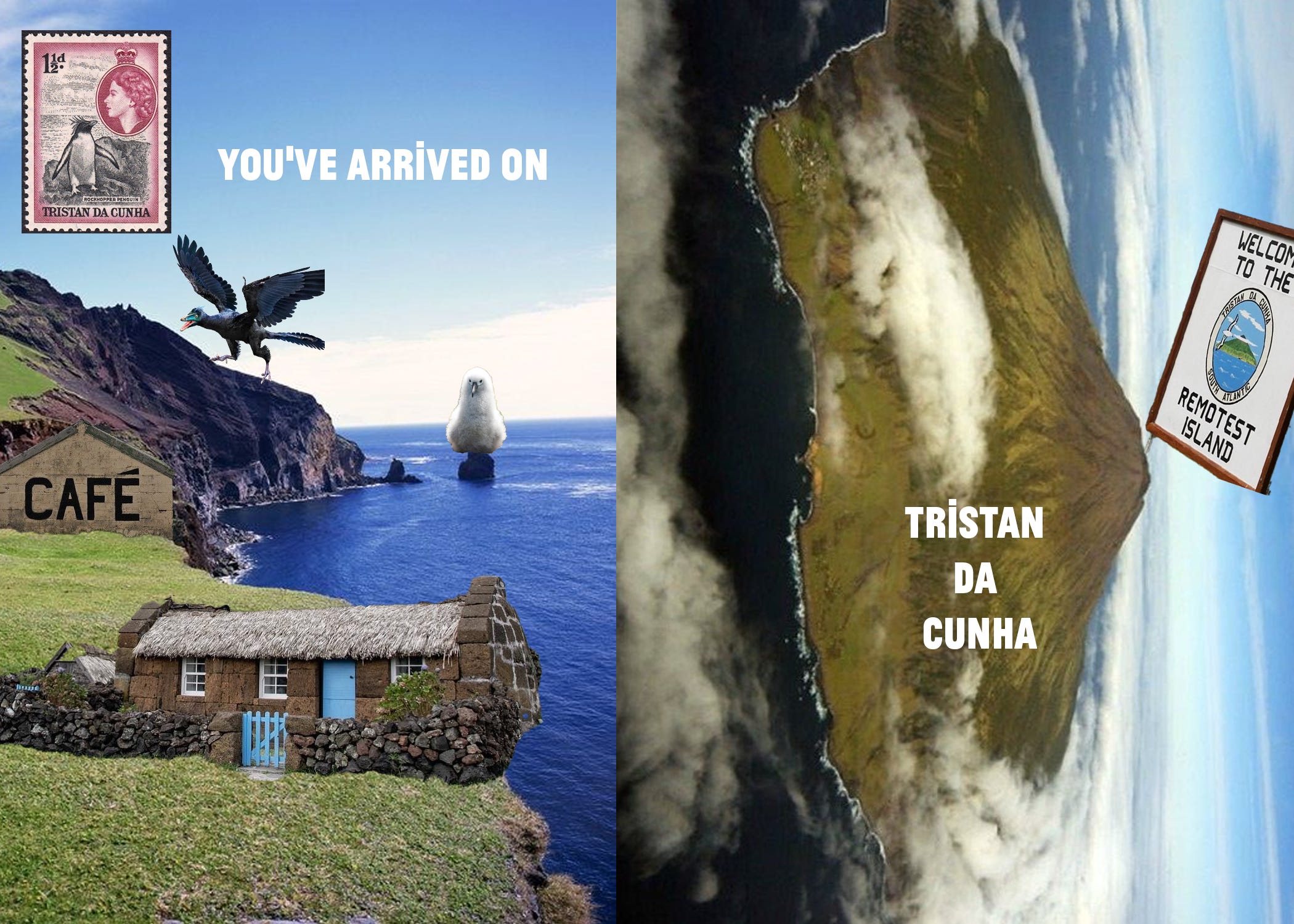
I had heard of Tristan da Cunha before as one of the most remote places in the world, but I had never heard of anyone living there. It takes 7-8 days by boat to reach, as the small volcanic island that’s home to about 300 people is waaay in the middle of the South Atlantic Ocean, in between Africa and South America. I have my gripes on TikTok, but the algorithm brought me to Kelly Green, who shares life living on the island. If I ever feel far away from home living in Florence, I have Kelly and Tristan da Cunha to put it in perspective. Humans are fascinating, and so is our planet.
For Today’s Reading
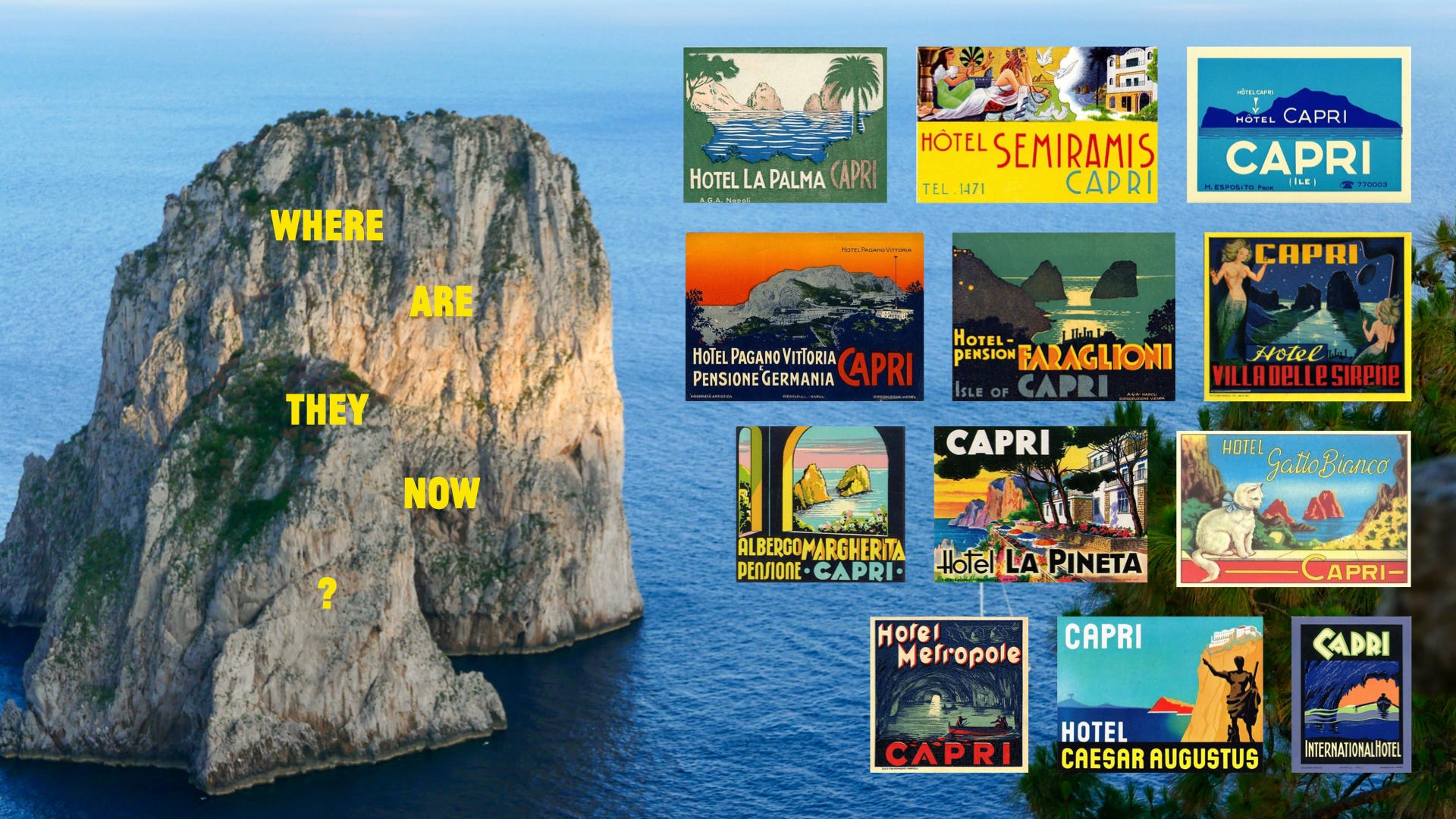
Where Are They Now? The first installment on a new series where I research the hotels from vintage luggage tags, today we go where I know best – Capri.
Be the First Guest of the Season on the Amalfi Coast – the lowest rates at the bucket list hotels and my reasoning as to why first might be best in this instance.
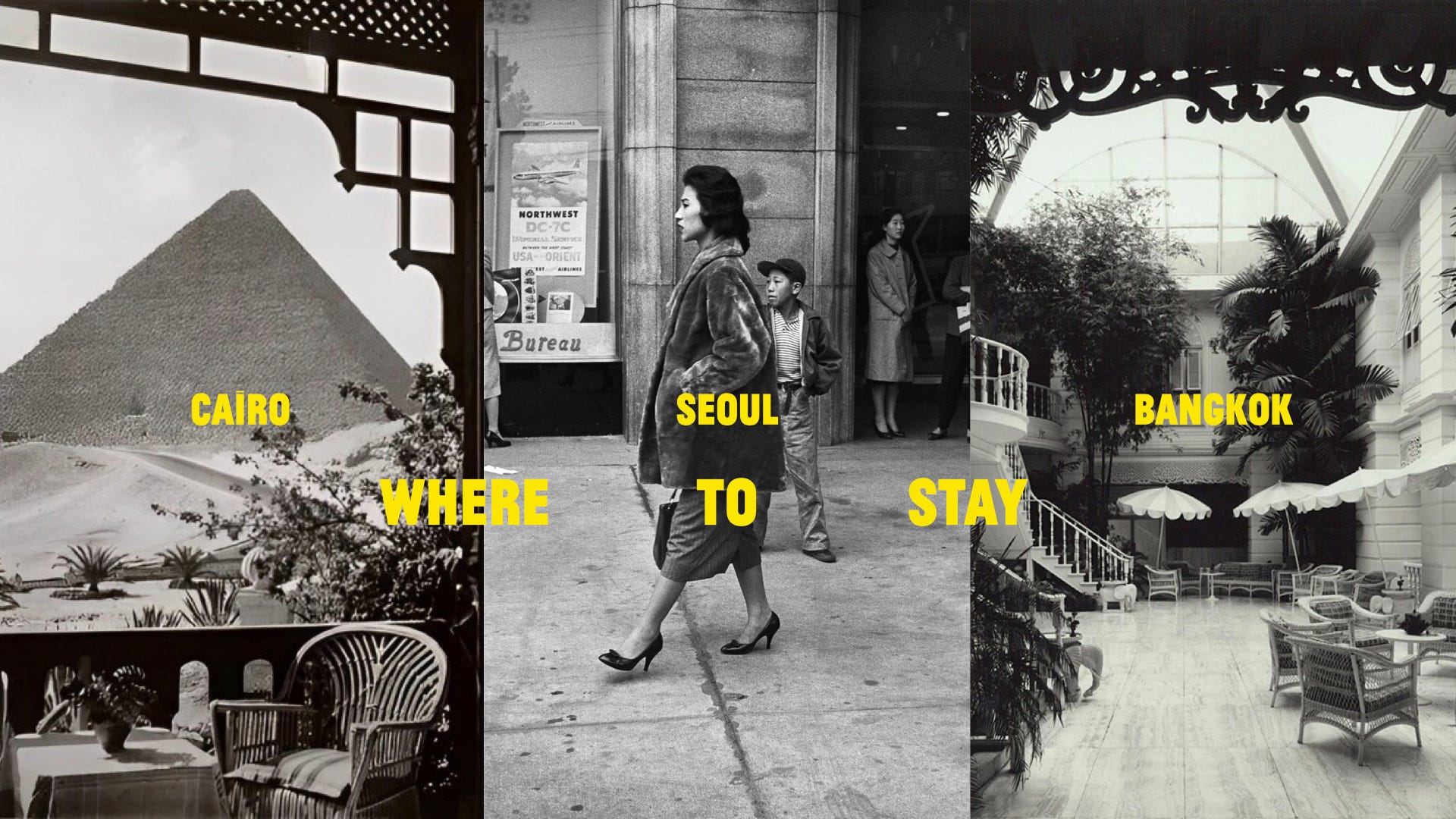
Human Seeking Hotel – answering three Instagram follower requests for hotels in three cities I haven’t properly covered before: Cairo, Seoul, and Bangkok.
The New(s) – 17 new and upcoming hotels to know about.
FYI I know I say it often but today’s post is particularly long, please click through to view in browser or the app if it gets cut off in your email.

Where Are They Now?
No, I’m not talking about one-hit-wonders or former Disney stars – instead, something more interesting. The hotels on old luggage tags. What’s still around? What’s there today? Has anything withstood the test of time?!
I’ve been “collecting” a library of them, mostly for color and typography reference. But then I started wondering about these places. Just because it’s old and has a pretty luggage tag doesn’t mean the hotel was great, after all. And, because I’m always searching for new-to-me hotels that are very old in reality, I thought I’d get to Googling.
It turns out it’s not an instantly easy feat, many of the hotels that no longer exist are hard to find a digital record of. This is when I’m glad I chose Art History as my major, because I do enjoy research. I started randomly, and not with the most beautiful of the designs for some reason.
I started with Hotel Beauregard, in Saint-Véran, a small ski resort in Normandy. First, I was curious if it still existed because I love this particular shape of old hotel, and also, I don’t know anything about Saint-Véran and thought what if it does still exist and what if it’s Special.
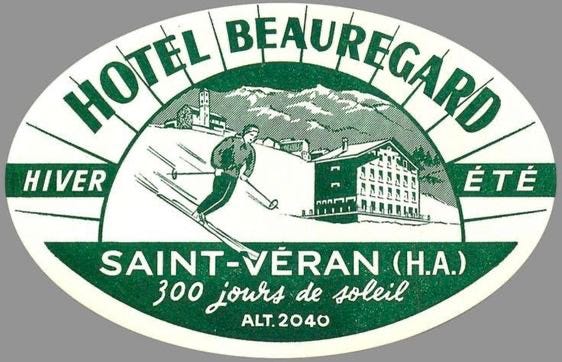
It does not still exist, BUT, deep in my research I found the below, which made me want to go all in on this idea. Something I talk about infrequently but think about often is the infinite stories that live at hotels, and in their legacies. I love them, which is probably why I’ll read any book set at a hotel. When I research The New(s), I get excited for the young people who are going out on a limb to create a special place for people to stay. It’s brave, and whether or not it becomes a hit, it etches a mark on that place’s history.
In searching for the lost legacy of Hotel Beauregard, I found myself on the town’s website, and found a page from an event that occurred in October to view the hotel archives. There was a note written by the former hotel owners’ daughter.
“Last January, I found 30 kg of documents in my parents’ cellar relating to the construction of the Beauregard Hotel (the hotel that was my first home, as my parents, Jean-Pierre and Claude Weber, ran it from 1964 to 1976). I wanted to share a slideshow I created after reading, sorting, and analyzing these archives, compiled between 1933 and 1938 by Pierre Isnel, a mining engineer and co-manager of the hotel. I’ve presented the letters, plans, and newspaper articles around four key points: Who were the residents of Saint-Véran who initiated this project? Why did they embark on such an ambitious undertaking? How was Beauregard built, and what were the beginnings of tourism and the hotel industry in Saint-Véran?
I presented this slideshow to my family last June and I think it might interest the people of Saint Véran, this hotel financed by families originating from the village, being part of the history and heritage of the village and the Queyras.
I believe the screening in June lasted 1 hour 15 minutes, and I hope this presentation will encourage both older and younger people to share their memories and knowledge afterwards, as I am always looking for testimonies and visual documents.
See you soon, I hope.
Sabine Weber”
I can’t tell you how giddy this made me – it made the world seem a little smaller, hotels a bit more significant, and the eras slightly shortened.
The hotel was established the same year my dad was, 1936, and became apartments when I was a sophomore in high school, in 2008. Sad, but I’m thrilled it wasn’t forgotten. And, it reminded me that there are other curious people out there who wonder the same sort of questions I do. It made me want to do this in the places I know and love, and then, if you like this idea, throughout the world. I have about hundreds and hundreds of hotels I can do this for, in all areas of the world, but I want to gauge interest so this first edition is paywall-free. Especially, because the gamut of good info didn’t come from me.
We’re starting in Capri, where I fell in love with hotels and where all the Google information is incorrect and where I have access to the truth via the people – the Caprese people, my people.
I texted Stefanie (my best friend, 3rd-generation Caprese, owns The Blue Kitchen Capri, and lives there year round) and asked her to ask her grandma (Nonna Gianna, or Nonna G) who has lived on the island her whole life and with her husband, owned the main nightclub in Capri for decades and is a true island treasure and treasure trove of information. Stefanie’s mom, Ester, who owns La Cucina di Ester, a cooking class and wine experience on her beautiful vineyard Cantina del Vesuvio just in front of the volcano, equally came in clutch with the info – she was also born and raised on Capri.
First, let’s start with what I did not need their help for, the hotels that still exist today. My beloved Hotel Caesar Augustus in Anacapri (the only one in Anacapri I looked into, to be honest), Hotel Gatto Bianco where my dad first stayed on the island in the 60s, Il Capri Hotel, Grand Hotel Quisisana (just called Quisisana, pronounced quee-zee-sah-nah), and Hotel La Palma.
The Quisisana started as a hospital, and then quickly became a hotel in the late-19th century, and has been owned and operated by the Morgano family (who I know, and who also own La Scalinatella and Casa Morgano) since the 1980s. Of the hotels on the island, it’s now the longest-standing with uninterrupted operation, a true fixture, although it would never be anywhere near the top 10 of my choices to stay on the island (for aperitivo, sure).
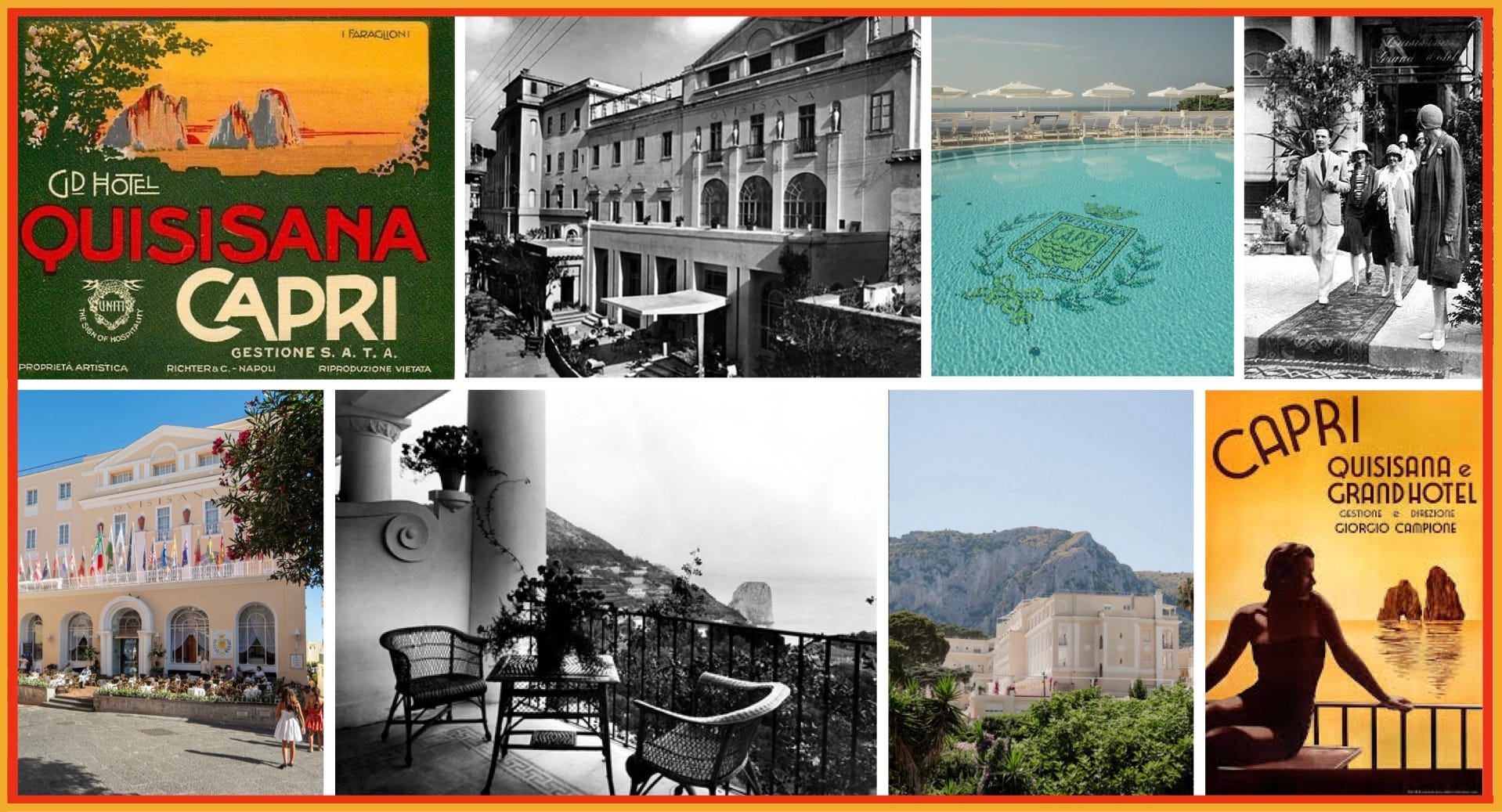
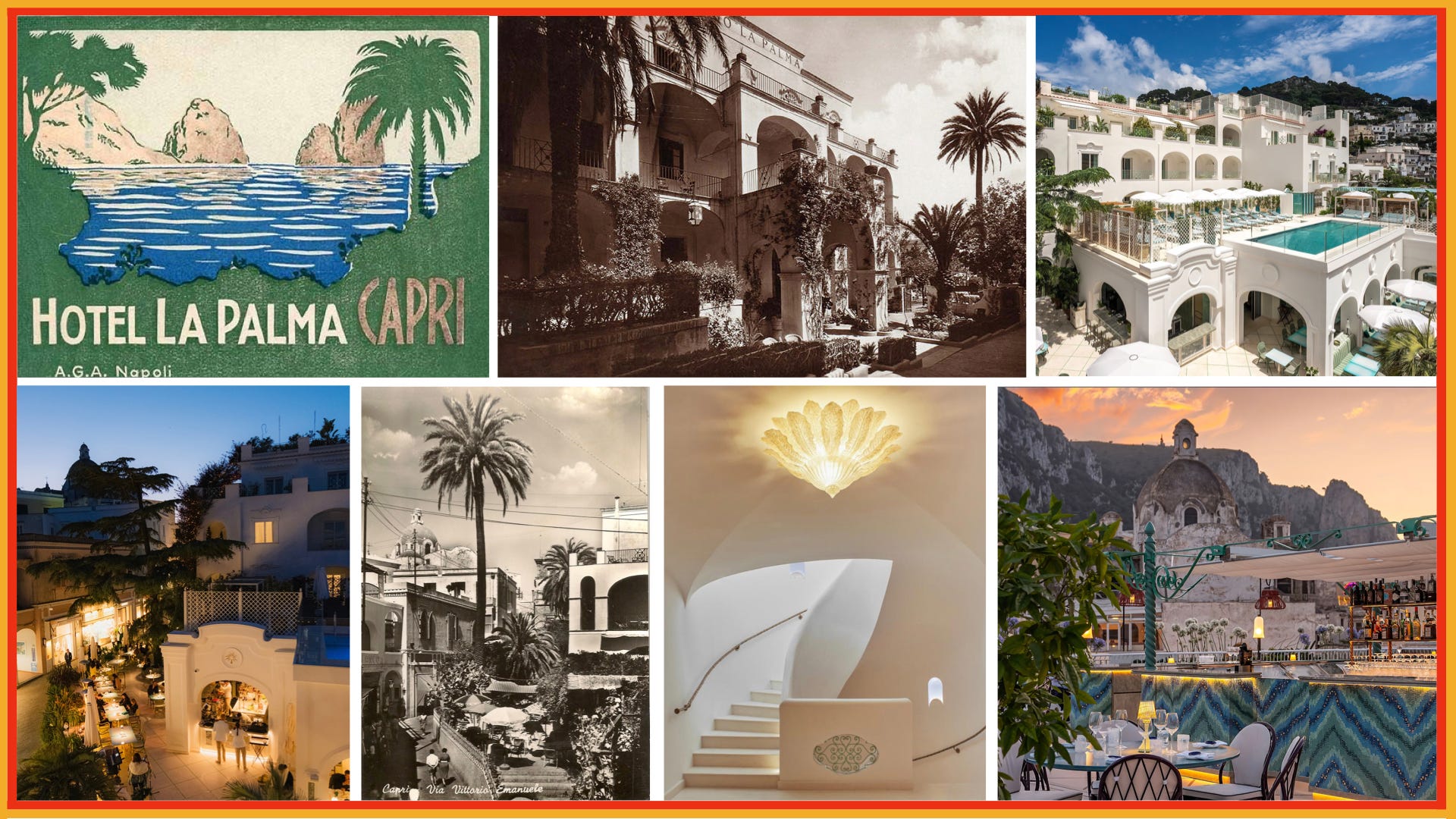
Then Hotel La Palma is famously the island’s oldest hotel. I thought it was called that from the jump, but I learned from Ester in this exercise that it was in fact first called Hotel Pagano. After being continuously operated until the pandemic, it was then procured by the Oetker Collection and they spent several years renovating it, and adding a pool, which it never had before. I’ve written my full, honest thoughts on the current hotel’s existence in the archive and with a paywall, but TLDR it’s surely luxurious and a current hot spot (which it hadn’t been prior for quite some time, except for their spa) but also not one of my personal top choices. The interiors are now and have always been starkly white, and their terrace has always been kind of considered dead center Capri. The incredible, iconic Taverna Anema e Core is below.
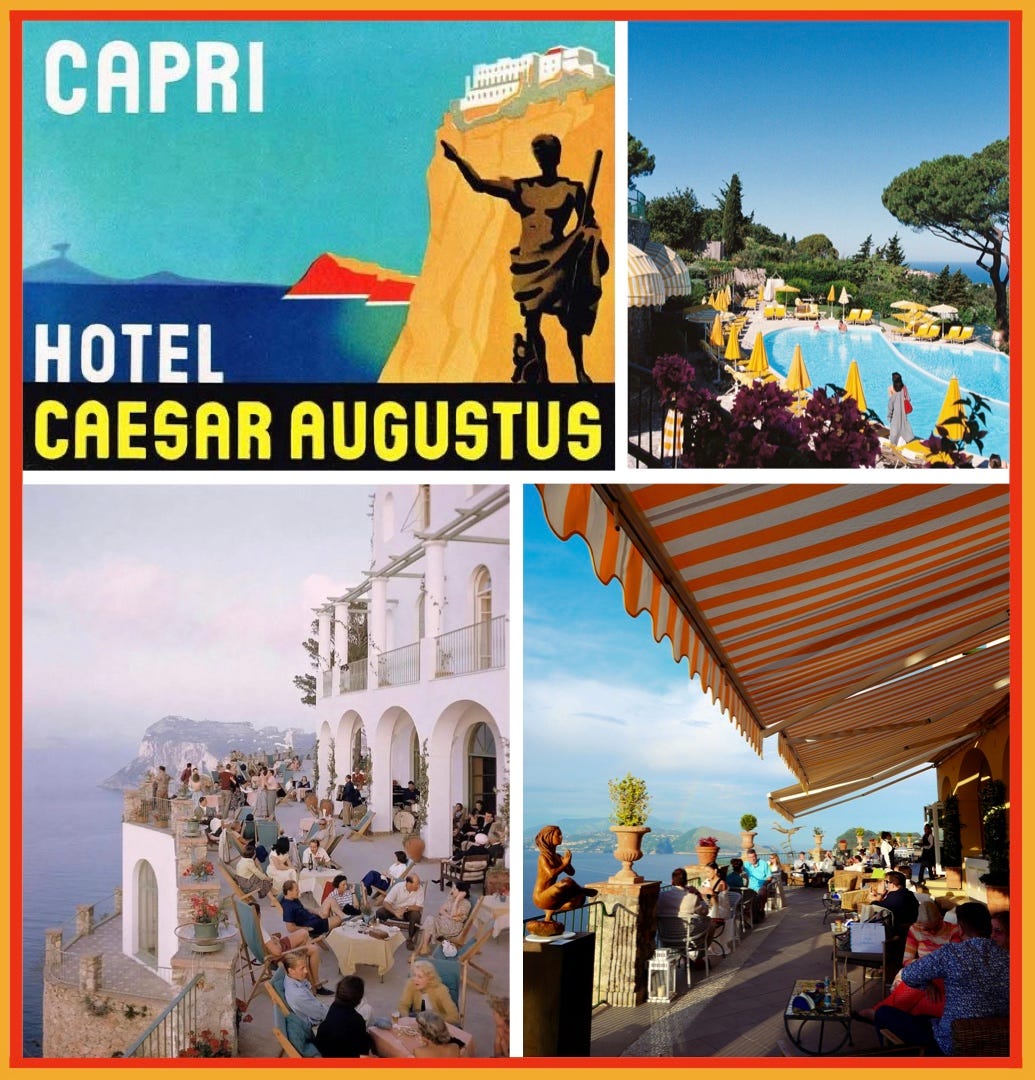
Hotel Caesar Augustus was first built in 1850 as a private villa, before becoming a hotel in 1940 and being Anacapri’s only hotel worth a hoot or a holler since (in my humble, honest opinion). One of the most iconic “Italian Summer” vintage photographs was taken on the terrace, by Ralph Crane in 1949. If you don’t need to see the faraglioni, it has the most magnificent views on the island, and arguably the island’s best hotel bar (go at sunset, pre-reserve if you’re not a guest). It was sold last year to Gruppo Statuto, but as of now remains untouched, completely under the charm of the Signorini family who have owned and run the hotel for decades and decades. When I stayed in 2023, I booked a base room and was greeted (as every guest was, TBD on if that will be the case this year) by Signore Francesco, the owner (the son, who eats lunch with his father Paolo at the fantastic restaurant La Terrazza di Lucullo every day) who sat with me on the magnificent terrace as I checked in and we got to talking and he, to my immense shock, wanted me to stay in the penthouse suite because it was free that night and he “much rather it go to someone who knows and loves this island and a local Caprese (Stefanie) than sit empty all night.” The pool is fantastic, too, and they have yellow bathrobes.
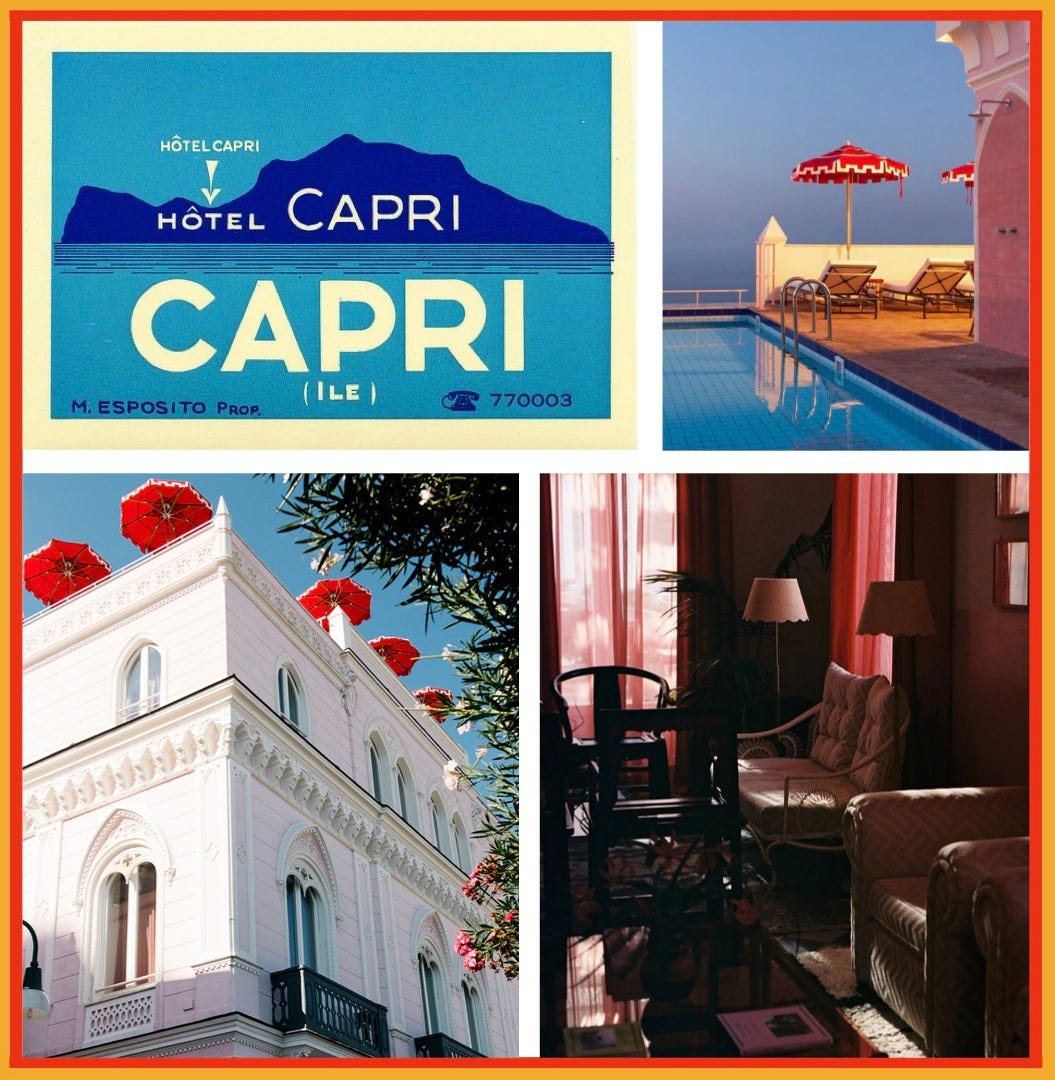
Il Capri Hotel used to be called Hotel Capri, and it’s located right by the taxi stand. Until a few years ago, it was owned and run by a Caprese family that I know (the grandfather designed the luggage tag), until it was bought by a cool young French couple (also Stefanie’s friends) who painted it pink, gave it fantastic branding, a locally-loved disco called Rumore, and a small rooftop pool. It’s very cute, and very photogenic, but it has no ties to its former identity (besides the fact that, funnily enough, the original luggage tag was in French) and isn’t one of my top five choices because of the location and because the rooms are small. For young people or party people, it’s definitely a go. And if you like house music, go dance.
I’m afraid I’ll bore you if I go so thoroughly through all the rest.
Hotel Gatto Bianco is across the street from Hotel La Palma, and was where my dad stayed on his first trip to the island in the 60s. It is, in every way, unremarkable besides the fact that it still exists. And, if you’re coming to party at Taverna for the night, it’s not a bad option if you’re hardly in the room. Really, no need for photos.
Now, we get to the good part, where Stefanie’s grandma, Nonna G, came in with the wisdom.
I was particularly curious about Hotel La Pineta, because based on the luggage tag, it seemed to be an illustration of the actual building, and from that vantage point, it had to be on Via Tragara, the most beautiful street on Capri. It turns out it is now Casa Morgano, which is very old school and hush-hush, connected to their sister property next door, Hotel La Scalinatella. Both are owned by the same Morgano family as Quisisana, and are very, very Caprese. Subdued, chic in their own way, and really old world. I’m happy to know it’s still a hotel, and run by such heavy-hitting family on the island.
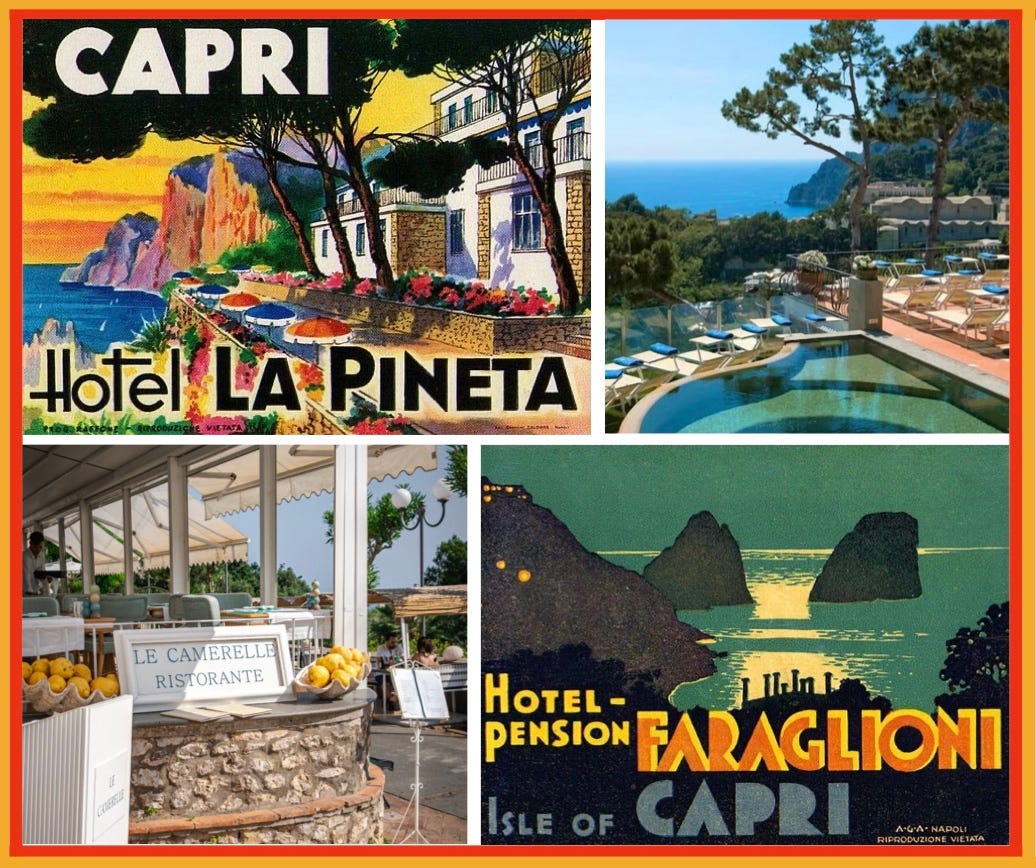
Arguably my favorite of the Caprese luggage tags was Hotel-Pension Faraglioni – the type of the word Faraglioni reminds me of the original Ferragamo logo, and I enjoy the light and shadow play. I wondered if this, perhaps, could be what was, for many years and a fixture in my childhood, the restaurant Faraglioni, on Via Camerelle. No! But, next door, in what is now the restaurant Le Camerelle (fine for a drink, meh for food, although great people watching) as well as the apartment next door. Interesting! I can’t imagine the space being a hotel.
Hotel Semiramis was the least exciting, it’s now apartments on Via Valentino, behind the hotel La Residenza. There’s an AirBnB or two for rent, but we can skip.
Hotel Pagano Vittoria was interesting, because there are very few abandoned buildings in Capri, but this is now one of them – the Telecapri Building, right by the hotel San Felice, adjacent-ish to the Quisisana. Location-wise, this could make a great hotel akin to Il Capri Hotel.
Pensione Margherita is one we’re not sure on. It’s definitely the villa called Villa Margherita next door to Hotel Canasta and their restaurant aptly named Villa Margherita, but we’re not sure if it occupied the hotel’s space as well. It’s owned by a friend of ours and her family, so I’ll update you all if you’re interested if and when I have an answer. It’s on the street I’ve spent the most time on, as the hotel we stayed at every summer growing up, Hotel Mamela, is just a few doors down. The best store on the island, Laboratorio Capri, is kitty corner, and the Certosa is around the corner. I thought I had one million photos of this corner, but it appears I don’t have a single one on my current iCloud and the Google Street View photo doesn’t do it justice. Boo!
International Hotel was the only one Nonna G was unsure of – it didn’t last long and was somewhere in Marina Grande.
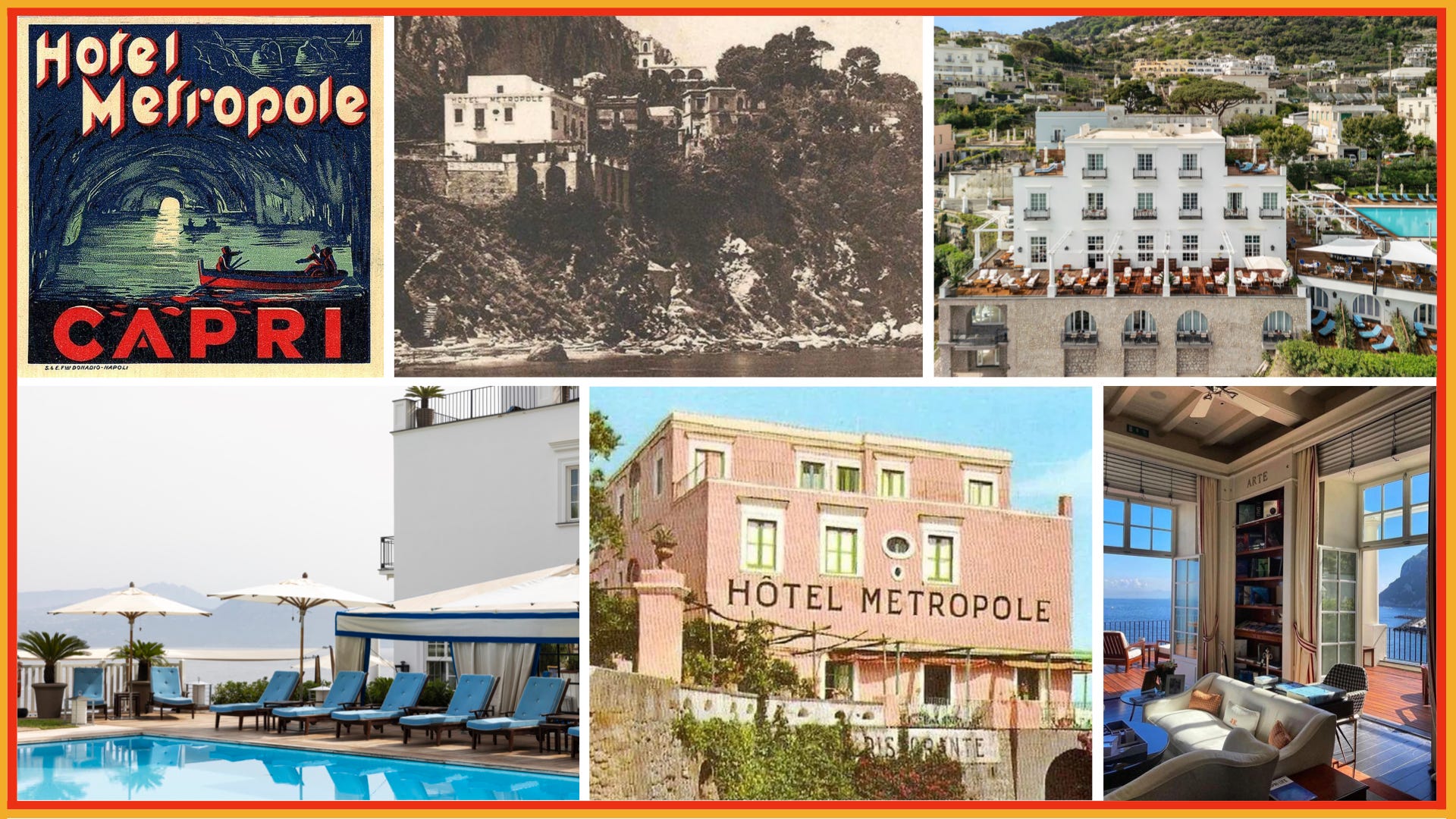
Which leads us to the last hotel, the reigning queen of Marina Grande, J.K. Place Capri, formerly Hotel Metropole. Look, so many people looooove the hotel, and it is beautiful and very well-designed. But, in my opinion, the beauty of Capri is that there are no cars and you walk everywhere in Capri central. If you stay in Marina Grande or Anacapri, this is not the case, and it loses the intimacy of the island. Still, it’s a very well run hotel and no one doesn’t like their stay, although it’s majority American. They win in terms of conveying the history of the place.
The Comprehensive Guide to Capri has all my recommendations to the island I’m so fortunate to be able to consider a second home, and a new 2026 version will be updated in February (a new link will be sent out to everyone who has previously purchased).
Now, tell me if you want me to make this a recurring series? Remember, I can’t see who voted what.

Human Seeking Hotel
Welcome to the new iteration of helping you find hotels for places you want to go. Last week, I asked on my Instagram Stories where in the world you wanted to travel in 2026 and need a recommendation for. So many wonderful places! So many I’ve written about and have full lists in the archive. Today, I’ll answer three that haven’t been properly answered previously – hotel suggestions for Cairo (Egypt), Seoul (South Korea), and Bangkok (Thailand).